Roots on the Table: The Cooks Behind October’s Supper Club
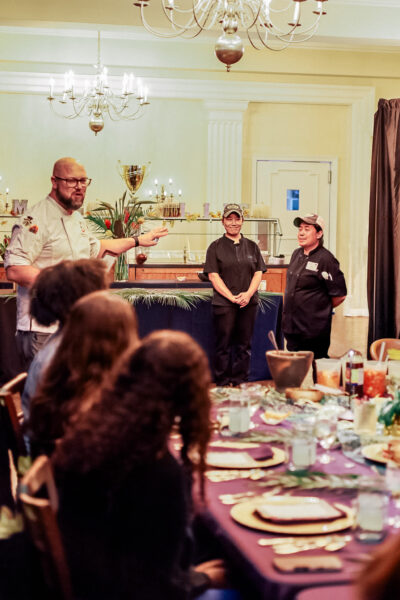
October 20, 2026, Magnolia Room, Winston-Salem, NC
The menu for October’s Supper Club was written by two women who cook in our kitchens every day, about the food they grew up eating.
Maw and Say Wah built most of it, with Chef Chris Blackburn and Chef Jonathan Burns helping turn their home cooking into plated courses. It’s the first dinner in a new series called Roots on the Table, built so our team can share the food that raised them.
Who Cooked It
Maw has been with Deacon Dining since 2015. She started in prep and trained her way into the kitchen at The Pit, where she cooks now. Off the clock she cooks for her church and her child’s events, and she’s constantly teaching herself new recipes.
Say Wah joined Harvest Table in 2018, serving students before moving into the kitchen in 2023. She cooks at the Vegan Station. She was born in Thailand and came to the United States at 14, and she still makes the food she grew up on at home with her daughter.
The Dishes
The night opened with a spread designed for sharing. At the center was Maw’s som tam, the green papaya salad pounded in a clay pot. The dish comes from northeastern Thailand, and its roots run back through the Mekong region to Lao cooking, where the pounding technique long predates green papaya’s arrival from the Americas. It came alongside pe kyaw garbanzo crackers with split pea dip, blanket shrimp, and a kabocha red curry shooter finished with balachaung.
Kanom jeeb came next. These dumplings are Thailand’s take on Chinese shumai, traditionally filled with pork and prawn. This version folded green curry paste into the prawn filling, a move that’s become common in modern Thai kitchens.
Then tom yum gai. The name comes from tom, to boil, and yam, tangy and mixed. The soup began as a rustic broth along Thailand’s Central Plains and the Chao Phraya River, where fishermen cooked freshwater prawns with lemongrass, galangal, and makrut lime leaves. Here it was made with lime-brined Poulet Rouge chicken, kaffir leaf, ginger, crispy skin, and mushroom.
The entrée was pad kra pao with holy basil, soy-cured heritage pork, a fried quail egg, and big egg noodle. It’s Thailand’s everyday meal, the one you can get anywhere, fast and cheap and loud with flavor.
Dessert brought two dishes with long histories. Khanom khai hong, or swan egg snack, dates to the reign of King Rama I. The king had a craving for water monitor eggs out of season, so Royal Concubine Waen, known for her cooking, invented an edible stand-in: oval dough balls filled with sweet mung bean paste and fried. It was originally named for the lizard whose eggs it mimicked, but the word carried unlucky associations in Thai, so it was renamed after the swan.
Beside it was khao tom mud, sticky rice with banana and black bean steamed in a banana leaf, served with mango zabaione and condensed milk lace. It’s a temple offering during Buddhist ceremonies, and historically it traveled well, feeding monks on long journeys. The packets are often tied in pairs to symbolize partnership. Making it is a family job, with recipes passed down from grandmothers and aunts, and the work of soaking rice, softening leaves, and tying the bundles usually done together.
What the Night Meant
For Say Wah, the best part was watching people try her food for the first time and getting to explain it to them. She said she’d do it again tomorrow.
For Maw, it was the teamwork. A full kitchen, everyone pulling in the same direction.
By the end of the night, other members of our hourly team had come up to watch, and several asked how they could cook the next one.